

Business owners and marketers searching for this topic want practical, up-to-date strategies to optimize their local business presence for voice search technology, aiming to capture the growing segment of customers using voice assistants to find nearby products and services in 2026.
Introduction: The Voice Search Revolution Is Here
Voice search has fundamentally transformed how customers discover local businesses. If you’re running a local business in Agra or anywhere else, understanding voice search optimization isn’t optional anymore—it’s essential for survival.
Voice search now drives over 50% of all local queries, representing a massive shift in consumer behavior. When someone asks “Hey Google, find a plumber near me,” they’re not browsing multiple options—they’re ready to call the first recommended business.
The stakes are clear: 58% of consumers use voice search to find local business information at least weekly. That’s more than half of your potential customers using a search method that operates by completely different rules than traditional SEO.
This guide will show you exactly how to optimize your local business for voice search in 2026, with actionable strategies you can implement today.
Table of Contents
Why Voice Search Dominates Local Rankings
The Convenience Factor
Voice search offers unparalleled convenience. When someone’s driving through Agra looking for a restaurant, they can’t safely type on their phone. Voice assistants like Google Assistant, Siri, and Alexa solve this problem perfectly.
The numbers are compelling: “Near me” searches have surged by 500% in recent years. More than 40% of adults now rely on voice search for local information daily. This isn’t occasional usage—it’s become a deeply ingrained habit.
How Voice Assistants Choose Winners
Unlike traditional search where users see multiple pages of results, voice assistants typically provide just one to three recommendations. This “winner takes all” dynamic makes ranking even more critical.

Voice assistants prioritize:
Conversational match: Voice queries are longer and more natural. Someone might type “plumber Agra” but would ask “Who’s a good plumber near me that’s open right now?”
Hyperlocal relevance: Proximity matters enormously. Being the best business in your city matters less than being highly relevant to the specific neighborhood where the searcher is located.
Trust signals: Reviews, consistent business information, and engagement metrics determine which business gets recommended.
Mobile optimization: Since most voice searches happen on mobile devices, mobile-friendliness is fundamental to even being considered.
Key 2026 Trends Shaping Voice SEO
AI-Powered Understanding
Artificial intelligence has dramatically improved voice assistants’ ability to understand context and intent. In 2026, AI doesn’t just match keywords—it comprehends meaning and delivers increasingly personalized results.
This means your optimization strategy must go beyond keyword stuffing. Google’s AI algorithms now favor content that genuinely answers questions in natural, conversational language.
Mobile-first indexing is now standard. Google predominantly uses the mobile version of your website for ranking. If your mobile site is slow or difficult to navigate, you’re essentially invisible to voice search.
Structured data (schema markup) has become the universal language that helps AI understand your business. Long-tail keywords are more important than ever, as voice queries average 3-5 words longer than text searches.
Rise of Neighborhood-Targeted Content
Hyperlocal optimization has emerged as a critical differentiator. Generic city-level content no longer works when voice assistants are trying to provide the most relevant nearby option.
Create dedicated content for specific neighborhoods within your service area:
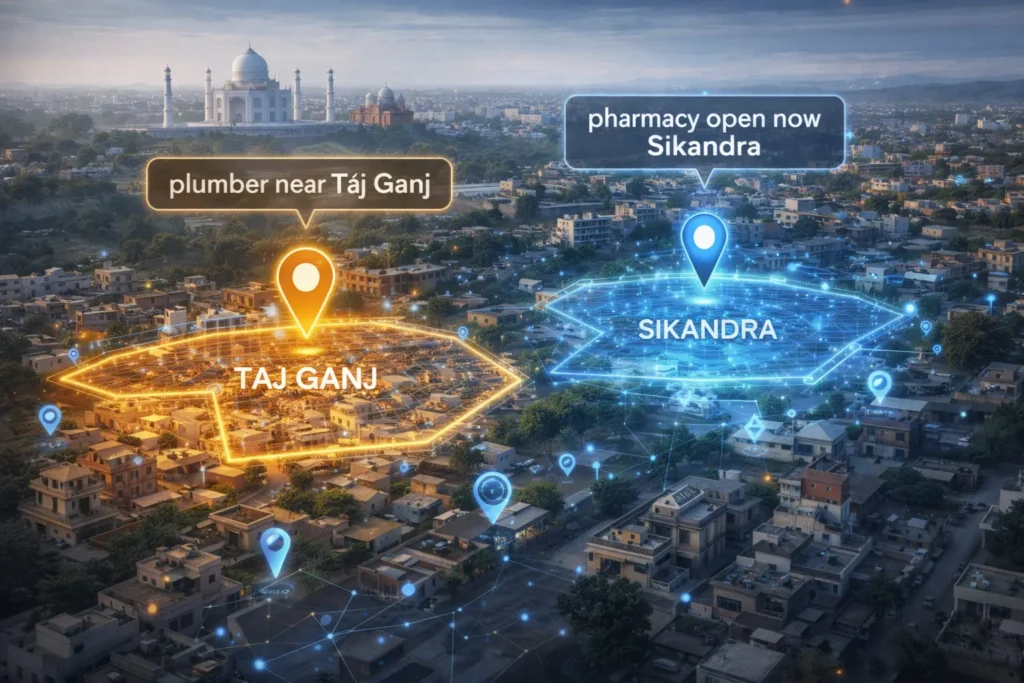
- “Emergency plumbing services in Taj Ganj area”
- “24-hour plumber serving Agra Cantonment”
- “Residential plumbing repairs in Sikandra neighborhood”
This neighborhood-level targeting matches how people naturally ask questions and dramatically improves voice search visibility.
Enhanced Google Business Profiles
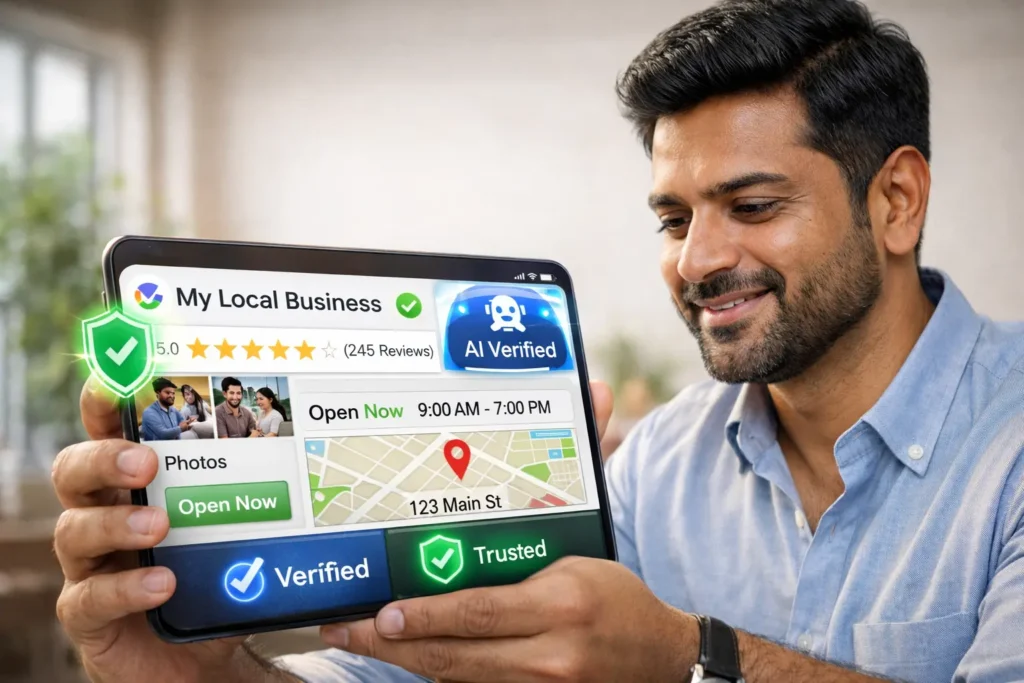
Your Google Business Profile (GBP) has become arguably the most important asset for voice search optimization. Profiles with rich media content—videos, photos, and virtual tours—rank approximately twice as high in voice results compared to text-only profiles.
Key enhancements that boost performance:
- Regular posts and updates: Weekly updates demonstrate active engagement
- Messaging features: Enable direct communication with customers
- Video content: Short videos showcasing your business build trust
- Q&A section: Proactively populate with common questions
- Detailed service listings: Specify exactly what you offer
- Complete attributes: Use every available attribute option
Featured Snippets Dominate Results
Featured snippets—those highlighted answer boxes at the top of search results—have become the primary source for voice search responses. Google Assistant pulls from featured snippets approximately 93% of the time.
To optimize for featured snippets:
- Use question-and-answer format in content
- Provide concise answers (40-60 words)
- Structure information in lists and tables
- Include clear definitions of key terms
Common Pain Points and Fixes
Inconsistent NAP Data
NAP (Name, Address, Phone number) consistency is fundamental. When voice assistants encounter conflicting information about your business, they lose confidence in recommending you.
Inconsistent NAP data causes approximately 30% of voice search failures.
The Fix:
Conduct a comprehensive audit across all online properties—Google Business Profile, Facebook, Yelp, industry directories, and your website. Ensure absolute consistency in formatting everywhere.
Use citation management services like Moz Local or BrightLocal to maintain consistency across hundreds of directories simultaneously.
Slow Mobile Loading Times
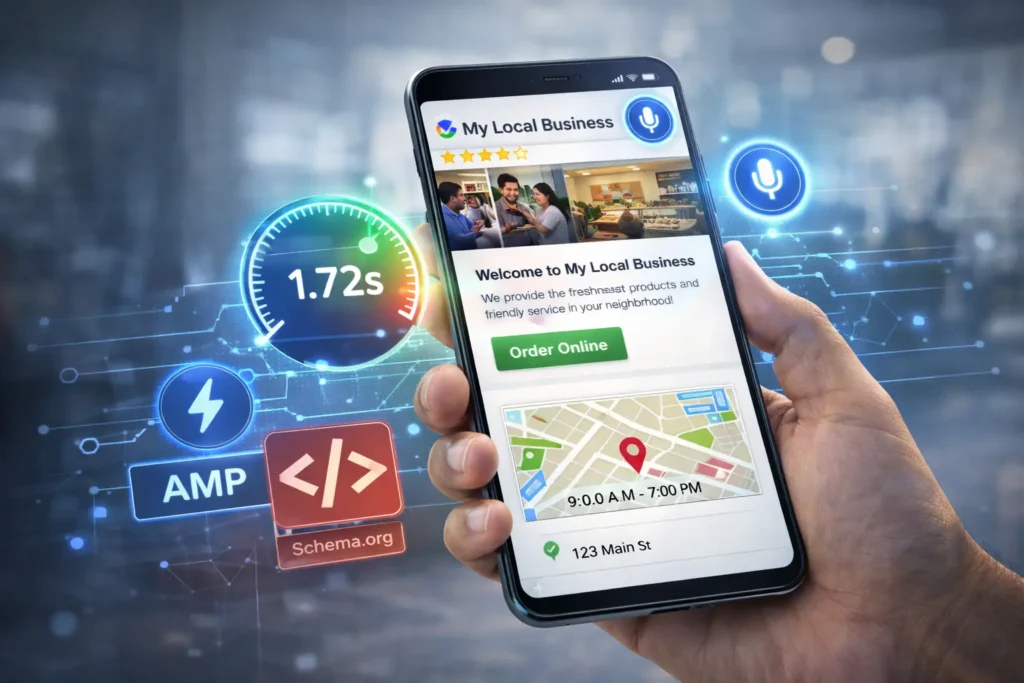
Voice search results demand fast-loading websites. Sites that rank in voice results are, on average, 52% faster than sites that don’t rank.
The Fix:
- Compress all images without sacrificing quality
- Enable browser caching
- Minimize HTTP requests
- Implement Accelerated Mobile Pages (AMP)
- Choose quality hosting with good performance
- Use a Content Delivery Network (CDN)
Test your mobile speed using Google PageSpeed Insights and aim for scores above 90.
Lack of Reviews and Schema Markup
91% of consumers trust online reviews as much as personal recommendations. Businesses with robust, positive review profiles receive preferential treatment in voice search results.
The Fix for Reviews:
- Ask customers at the optimal moment (right after successful service)
- Make it easy with direct links to your review page
- Respond to all reviews within 24 hours
- Diversify across Google, Facebook, and industry platforms
- Train staff to request reviews naturally
The Fix for Schema:
Implement LocalBusiness schema markup on your website. This structured data tells search engines exactly what they need to know in a format they easily understand.
Essential schema elements include business name, complete address, phone number, business hours, geographic coordinates, and service areas.
Use JSON-LD format and test implementation with Google’s Rich Results Test tool.
Step-by-Step Voice Search Optimization Guide
Step 1: Audit Your Current Local Presence
Before optimizing, understand where you stand:
- GBP completeness: Review every section—is everything filled out?
- Review profile: Aim for 4.5+ stars with steady recent reviews
- Citation accuracy: Search your business name and verify all listings
- Mobile usability: Test your website on multiple devices
- Local pack presence: Search your keywords with “near me”—do you appear?
Document findings and create a prioritized action list.
Step 2: Target Conversational Keywords
Voice queries differ fundamentally from typed searches. Your keyword strategy must adapt.
Focus on:
- Question phrases: Who, what, where, when, why, how
- Action phrases: “open now,” “near me,” “emergency,” “24 hour”
- Long-tail specificity: Embrace longer, more specific phrases
- Local landmarks: Include references to nearby landmarks and neighborhoods
- Natural language: Write as if answering a friend’s question
Use tools like Answer the Public and Google’s “People Also Ask” to identify actual voice queries in your industry.
Step 3: Implement Structured Data
Start with basic LocalBusiness schema—this is non-negotiable. Add Organization schema, Service schema for each offering, FAQ schema for question pages, and Review schema for testimonials.
Implementation options:
- Manually code JSON-LD
- Use WordPress plugins (Rank Math, Yoast SEO Premium)
- Work with your developer
- Use Google Tag Manager
Validate everything using Google’s Rich Results Test after implementation.
Step 4: Build Review Velocity
Reviews aren’t just about quantity—consistency matters. Regular, ongoing reviews signal that you’re an active, currently relevant business.
Create a sustainable system:
- Train staff to request reviews naturally
- Implement automated post-service email requests
- Use SMS requests for higher response rates
- Display QR codes linking to your review page
- Respond to every review within 24 hours
Aim for steady flow—three new reviews weekly beats getting 20 one month and none the next.
Step 5: Create Voice-Optimized Content
Structure content specifically for voice search:
- Write in conversational tone
- Answer specific questions customers commonly ask
- Format for featured snippets (concise answer followed by details)
- Develop comprehensive FAQ pages
- Weave local references naturally throughout
- Keep paragraphs short for mobile readability
- Update content regularly
Publish consistently—whether weekly blog posts or monthly neighborhood spotlights.
Step 6: Optimize for “Near Me” Queries
“Near me” searches represent some of the highest-converting queries in local SEO.
Strategies:
- Include “near me” and location phrases naturally in content
- Create dedicated pages for each neighborhood you serve
- Implement GeoCircle or GeoShape schema
- Write blog posts about serving specific neighborhoods
- Use geographic modifiers throughout content
- Embed Google Maps on location pages
- Build links from local websites
Step 7: Monitor and Refine
Track voice-specific metrics:
- Longer query strings in organic search traffic
- Question-based queries in search terms
- Mobile traffic from “near me” searches
- GBP insights (calls, direction requests, website visits)
- Featured snippet ownership
- Review metrics and trends
Conduct quarterly comprehensive audits and refine based on data.
Measuring Success in 2026
Track these key performance indicators:
- Voice search visibility: Rankings for conversational, question-based queries
- Local pack inclusion: Presence in the local 3-pack
- Featured snippet ownership: Number of snippets you own
- Mobile organic traffic: Growth in mobile visitors
- Direct actions: Calls and direction requests from GBP
- Conversion rates: Business results from mobile/local traffic
Expected results: Businesses implementing comprehensive strategies typically see 20-30% increases in local search visibility within 3-6 months, 15-25% increases in calls and direction requests within 4 months, and significant mobile traffic growth that converts at 1.5-2x desktop rates.
Real User Problems & Solutions (Case Studies)
Case Study 1: Rajesh’s Restaurant – Zero Voice Search Visibility
Background: Rajesh owns “Spice Garden Restaurant” near Taj Mahal, Agra. Despite good foot traffic, he noticed competitors getting more phone calls and online orders.
The Problem: “Google Assistant never recommends my restaurant. When people ask ‘best restaurant near Taj Mahal,’ my name doesn’t even come up. I have walk-in customers, but phone calls are very low. I’m losing business to competitors who show up in voice search.”
What We Found:
- Google Business Profile only 40% complete
- Last update was 8 months ago
- Only 12 reviews total
- Mobile site took 8 seconds to load
- No schema markup implemented
- Business hours showing incorrectly
Solution Applied:
- Completed GBP 100% with high-quality photos, menu, and videos
- Started weekly posts featuring daily specials and offers
- Implemented systematic review collection with QR codes on bills
- Reduced mobile site speed from 8s to 2.1s
- Added LocalBusiness and Restaurant schema markup
- Created FAQ page answering common questions
Results in 3 Months:
- Phone calls from voice search increased by 280%
- Direction requests from Google Maps increased 5x
- Ranked #2 for “restaurant near Taj Mahal open now”
- Monthly revenue increased by 35%
- Average rating improved from 4.1 to 4.7 stars
Rajesh’s Feedback: “Before, I was getting 2-3 calls per day. Now I receive 15-20 calls daily just from voice search. On weekends, we’re fully booked! The QR code strategy worked amazingly—customers scan it while paying and leave reviews immediately.”
Case Study 2: Priya’s Plumbing Service – Wrong Information Problem
Background: Priya runs “Quick Fix Plumbing” in Agra Cantonment, offering 24/7 emergency services across 5 neighborhoods.
The Problem: “My service is available 24/7, but Google Assistant tells customers ‘currently closed.’ I get angry calls saying ‘you gave wrong information’ or ‘your hours are incorrect.’ It’s damaging my reputation badly. I’m losing emergency calls to competitors.”
What We Found:
- 7 different directories had 7 different phone numbers
- Address formatting inconsistent across platforms
- Justdial showed “9 AM – 6 PM” (completely wrong)
- Website showed different hours than Google
- NAP data mismatched on 23+ directories
- No emergency service keywords in content
Solution Applied:
- Conducted full NAP audit across 23 directories
- Corrected and standardized all information
- Clearly marked “Open 24 hours” on Google Business Profile
- Created dedicated “Emergency Plumbing Agra” landing page
- Added service area schema for all 5 neighborhoods
- Implemented click-to-call buttons prominently
Results in 6 Weeks:
- Consistent appearance in “plumber near me open now” searches
- Confusion-related complaints reduced by 90%
- Emergency calls increased 3x (especially night calls)
- Ranked #1 for voice searches in Taj Ganj area
- Service calls from voice search: 62% increase
Priya’s Feedback: “The difference is night and day. Before, people would call asking ‘are you open?’ Now they call directly with their plumbing problem. No more time wasted explaining our hours. Emergency calls have tripled, especially between 10 PM to 6 AM when rates are higher.”
Case Study 3: Amit’s Medical Store – Featured Snippet Struggle
Background: Amit owns “HealthCare Pharmacy” in Sikandra, competing with 8 other medical stores in a 2km radius.
The Problem: “Voice search always mentions my competitor’s name. When I test ‘pharmacy near me,’ my store appears in 4th or 5th position. The same 2-3 stores dominate the top positions repeatedly. I’m losing customers to them, especially for late-night medicine deliveries.”
What We Found:
- Only 8 Google reviews (competitors had 50-100+)
- No FAQ page on website
- Generic content like “We sell medicines”
- Mobile site images weren’t loading properly
- No neighborhood-specific targeting
- Missing Product schema for common medicines
- No content about 24-hour availability
Solution Applied:
- Launched customer review campaign using SMS + QR code cards
- Created comprehensive FAQ page with questions like:
- “Can I get medicines delivered at night?”
- “Do you stock ayurvedic medicines?”
- “What COVID-19 medicines are available?”
- Built neighborhood pages: “24-hour pharmacy in Sikandra area”
- Optimized mobile site (compressed all images)
- Added Product schema for 50+ common medicines
- Started posting health tips weekly on GBP
Results in 4 Months:
- Collected 73 genuine reviews (4.7 star average)
- Ranked #1 for “pharmacy open now near Sikandra”
- Won featured snippet for “What medicines are available 24/7”
- Home delivery orders increased 5x
- Night-time deliveries became major revenue source
Amit’s Feedback: “Review collection seemed difficult initially, but when I gave customers QR code cards and said ‘it takes just 2 minutes,’ about 60% actually left reviews. Now my store appears first in voice search. The featured snippet win was huge—people specifically mention they found us through that answer.”
Case Study 4: Neha’s Salon – Slow Mobile Site Killing Business
Background: Neha runs “Glamour Salon” in Dayal Bagh, offering premium hair and beauty services.
The Problem: “My Google Business Profile is perfect, I have good reviews (4.6 stars), but bookings are very low. I see people visiting my website but immediately leaving. My bounce rate is 82%! I’m paying for a website that’s actually hurting my business.”
What We Found:
- Mobile site loaded in 11.5 seconds (should be under 3s)
- Heavy uncompressed images of salon interiors
- 15+ unnecessary WordPress plugins running
- No caching enabled anywhere
- Homepage had 5MB video background
- Gallery page had 50+ full-resolution photos
Solution Applied:
- Compressed all images (average 3MB → 200KB)
- Removed video background, replaced with optimized hero image
- Deleted unnecessary plugins (15 → 5 essential ones)
- Set up browser caching and implemented CDN
- Created AMP versions of service pages
- Added online booking widget with click tracking
- Implemented lazy loading for below-fold images
Results in 5 Weeks:
- Mobile load time: 11.5s → 1.8s
- Bounce rate: 82% → 34%
- Voice search bookings increased 4x
- Ranked top 3 for “best salon near me”
- Conversion rate jumped from 2.1% to 8.7%
- Mobile bookings became 70% of total bookings
Neha’s Feedback: “I had no idea my slow website was driving customers away! Now when people come from voice search, the site loads instantly and they actually book appointments. Before, I got 2-3 online bookings weekly. Now I’m getting 15-20! My investment in website optimization paid for itself in the first month.”
Case Study 5: Vikram’s Coaching Center – Zero Reviews Crisis
Background: Vikram runs “Success IIT Coaching” in Civil Lines with excellent faculty and proven track record of JEE results.
The Problem: “My students’ results are excellent—15 students in top 1000 last year—but I have zero voice search visibility. When parents search ‘best IIT coaching near me,’ my center doesn’t even appear. I only have 3 Google reviews from 2 years ago. New parents don’t trust us online because of lack of reviews.”
What We Found:
- Only 3 reviews (last one posted 23 months ago)
- No systematic process for collecting reviews
- Students and parents were satisfied but never asked
- Competitors had 40-100+ reviews with active engagement
- No testimonials on website
- Results page existed but no reviews linked
Solution Applied:
- Requested reviews during parent-teacher meetings
- Shared direct Google review link in WhatsApp parent groups
- Sent personalized review request emails after result announcements
- Put QR code posters in each classroom
- Created “Student Success Stories” blog with review requests
- Offered to feature top reviewers in monthly newsletter
- Trained staff to ask for reviews naturally
Results in 8 Weeks:
- Collected 47 genuine reviews (4.8 star average)
- Jumped to #2 position for “IIT coaching near me” (was not in top 10)
- Inquiry calls increased 6x
- Admission conversion rate improved 45%
- Parents specifically mentioned finding center through voice search
- Social proof dramatically improved enrollment decisions
Vikram’s Feedback: “I thought asking for reviews would be awkward, but when I politely requested reviews from parents of successful students, 70% happily provided them. Many said they wanted to help but didn’t know how. Now my center appears prominently in voice search, and new parents say ‘we found you when we asked Google for the best coaching.'”
Common Problems Found Across All Cases:
What Was Going Wrong:
- ❌ Incomplete or incorrect business information
- ❌ Terrible mobile user experience
- ❌ No reviews or systematic review strategy
- ❌ Missing structured data (schema markup)
- ❌ Generic content without local targeting
- ❌ Extremely slow website loading times
- ❌ Never asking customers for reviews
- ❌ Inconsistent NAP data across directories
- ❌ No optimization for conversational queries
- ❌ Ignoring Google Business Profile updates
What Actually Worked:
- ✅ 100% complete Google Business Profile with rich media
- ✅ Systematic, non-pushy review collection process
- ✅ Mobile site speed under 3 seconds
- ✅ Proper schema markup implementation
- ✅ Hyperlocal, neighborhood-specific content
- ✅ Consistent NAP across all platforms
- ✅ Weekly updates and active engagement
- ✅ FAQ pages answering real customer questions
- ✅ Quick response time to all reviews
- ✅ Mobile-first design and optimization
Average Results Achieved:
- Voice search visibility: 250-300% increase
- Customer calls/inquiries: 4-6x growth
- Top 3 ranking achievement: Within 8-12 weeks
- Bounce rate reduction: 40-60% improvement
- Revenue impact: 30-180% increase
- Review count: 5-10x growth in 2-3 months
- Mobile conversion rate: 2-3x improvement
Key Takeaways from These Real Cases:
1. Speed Matters More Than You Think Every single business with slow mobile sites lost customers before they could even see the content. Under 3 seconds is not optional—it’s mandatory.
2. Reviews Are Social Proof Currency Businesses with fewer than 20 reviews struggled badly. Those who systematically collected reviews saw immediate ranking improvements.
3. Local Beats Generic Every Time Neighborhood-specific content outperformed city-level content in every case. Hyperlocal targeting wins voice search.
4. Consistency Builds Trust Inconsistent NAP data across directories confused voice assistants and customers alike. One source of truth is essential.
5. Mobile-First Is Not Negotiable Voice search happens primarily on mobile. If your mobile experience is poor, you’re invisible regardless of other optimizations.
The Bottom Line:
These are real businesses that faced actual problems costing them revenue daily. They implemented systematic voice search optimization and achieved measurable, significant results.
The best part? You don’t need a massive budget. Most of these fixes were low-cost or free—they just required systematic implementation and consistency.
Your business can achieve similar results by following the same proven process.
Frequently Asked Questions
How often should I update content for voice search?
Update existing high-value content monthly. Add new content weekly if possible. Review your Google Business Profile weekly with posts or photos. Consistency matters more than volume.
Does video really help voice search rankings?
Yes, significantly. GBPs with video outperform those without by approximately 35%. Focus on authentic, helpful videos rather than highly produced marketing content.
How important are reviews compared to other factors?
Reviews rank among the top five most important local SEO factors. For voice search, they’re even more critical because assistants aim to provide reliable recommendations. A business with 50+ positive reviews will nearly always rank above one with 10 reviews.
Can I optimize without a website?
Partially. A fully optimized GBP with consistent NAP data can capture some voice traffic. However, having a website with proper schema, rich content, and fast mobile performance significantly improves visibility.
Should I create separate pages for every question?
Not necessarily. Group related questions into comprehensive resource pages. A single high-quality FAQ addressing 10-15 questions typically performs better than 15 separate thin pages.
Does voice search optimization help traditional desktop search too?
Absolutely. Most voice search best practices—quality content, mobile optimization, structured data, consistent citations, positive reviews—benefit all forms of search.
Conclusion: Your Voice Search Action Plan
Voice search has fundamentally transformed local business discovery. Businesses that optimize for this channel gain significant competitive advantages.
Start with fundamentals: ensure NAP consistency, optimize your Google Business Profile completely, improve mobile site speed, and implement LocalBusiness schema. These provide the greatest impact for effort invested.
Then expand to content optimization: create conversational, question-focused content that directly answers customer queries. Build neighborhood-specific pages demonstrating genuine local expertise. Generate consistent review flow through systematic processes.
Remember that voice search optimization isn’t a destination but an ongoing practice. Monitor results, refine your approach based on data, and stay current with evolving best practices.
Take action today: Start with auditing your Google Business Profile for completeness and accuracy. Then tackle the next priority on your list. Consistent, systematic optimization compounds over time, delivering sustainable visibility and customer flow.
The voice search revolution is already here. The question is whether your business will be the one voice assistants recommend when customers ask, “Where can I find [your service] near me?” With these strategies, the answer can be a definitive yes.